.png?width=365&height=122&name=BTLogo%20(1).png)

The Basis Theory Portal has been rebuilt from the ground up. You can now manage your tenant, configure resources, and build your integration on a modern, faster foundation with a refreshed UI aligned to our current brand standards.
The new Portal runs on the latest Next.js framework with a simplified component architecture designed for speed, both in the app itself and in how quickly we can ship improvements to it. Navigation has moved to the top of the screen, matching the patterns you're used to in modern admin consoles. Every feature you relied on in the previous Portal works the same way. This is a refresh of the experience, not a re-architecture of functionality.
Why does this matter?
- A consistent experience across every Basis Theory touchpoint, from docs to dashboard to SDKs.
- A modern foundation that eliminates compliance friction from outdated dependencies and enables faster iteration on Portal features.
- The groundwork for upcoming improvements to onboarding and observability.
Test Tenant Environments
Test tenants now run on dedicated infrastructure, fully isolated from production. If you use test tenants for integration testing or development, update your base URL to api.test.basistheory.com for all test tenant API calls.
The latest versions of our SDKs support a test environment parameter, so upgrading your SDK and specifying the test environment is the simplest path. If you call the API directly, update your base URL and add the new IP addresses (18.191.73.1 and 52.13.142.52) to any third-party allowlists. Webhook verification now uses a v1-test signature version, so implement dynamic signature verification if you haven't already. Full details are in our Test Tenants documentation.
Why does this matter?
- Production isolation is stronger. Test traffic no longer shares compute or infrastructure with live customer workloads.
- You can test more aggressively without worrying about impacting production reliability or triggering false alerts.
- A dedicated test environment gives you a stable, predictable surface for integration testing and CI pipelines.
Elements v3 Beta
The beta release of Elements v3 is now available for use. You can start building with the next generation of our embeddable UI components, featuring a unified card element that combines card number, expiration, and CVC into a single, streamlined input.
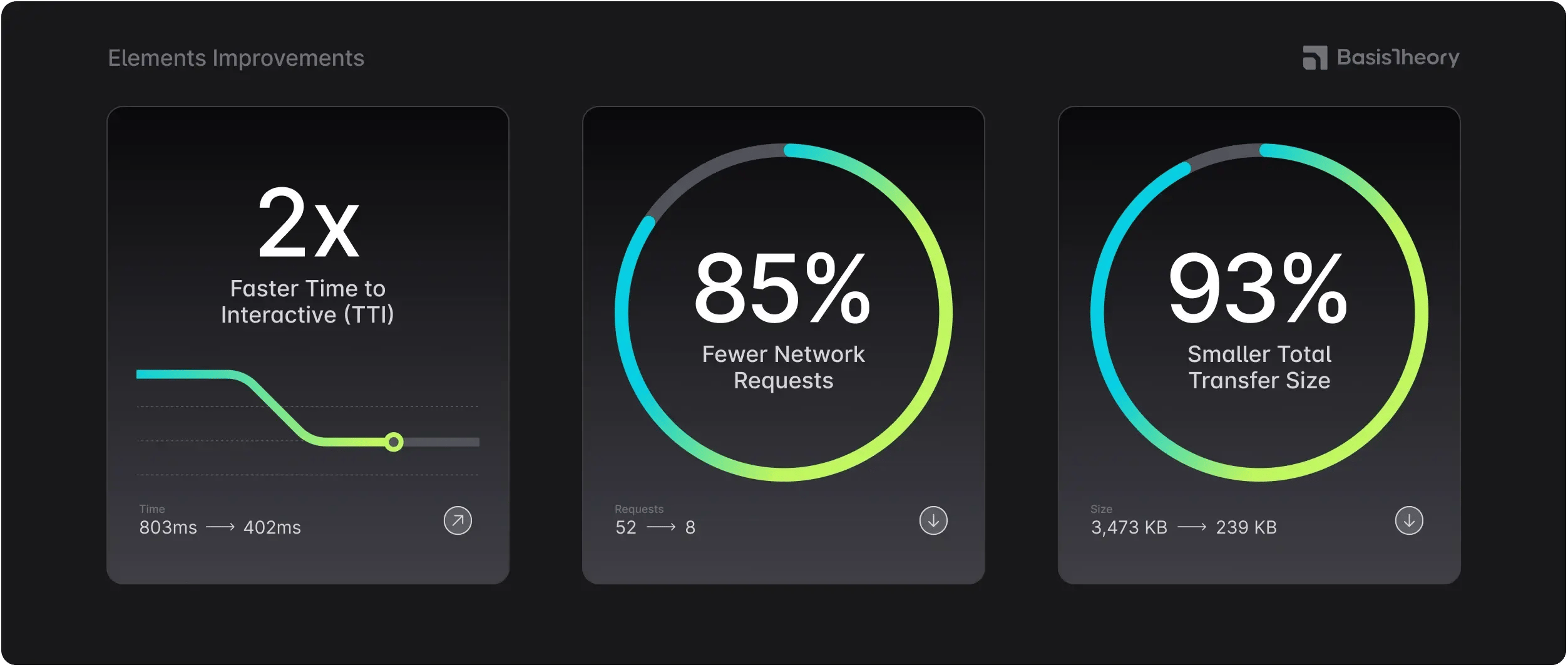
The rebuild delivers measurable performance gains: 2x faster time to interactive (803ms down to 402ms), 85% fewer network requests, and 93% smaller total transfer size. For end users on mobile networks or international connections, that lighter footprint is the difference between a checkout that feels instant and one that loses the customer. Elements v3 also introduces a design token system: you define your colors, typography, spacing, borders, and shadows once at initialization, and every Element inherits them automatically, including dark mode support.
No more duplicating style configurations across each field.
Why does this matter?
- Faster checkout load times directly impact conversion rates. A form that becomes interactive in 400ms instead of 800ms means fewer customers abandoning the page before they even start typing.
- The design token system eliminates repetitive per-element styling. Define your theme once and every Element inherits it, including dark mode, cutting implementation time and reducing support overhead.
- The upgrade path from Elements v2 was designed around real usage patterns. Core workflows map cleanly to the v3 beta, so you get the performance and developer experience gains without a painful migration.
3DS Session Metadata in Webhooks
You can now pass custom metadata on the Authenticate Session call and have it returned in all subsequent 3DS webhooks. This means your backend can attach order IDs, internal references, or any context your systems need to correlate a 3DS event back to the original transaction, without exposing that data on the frontend.
Metadata passed at session creation can also be enriched further during authentication, giving you a single place to track everything downstream.
Bug Fixes
Python SDK Transport-Level Retry Logic
Fixed an issue with the Python SDK's transport-level retry logic that could cause requests to not be retried correctly under transient network failures. The SDK now handles retries as expected, improving reliability for server-side integrations using basis-theory-python.